


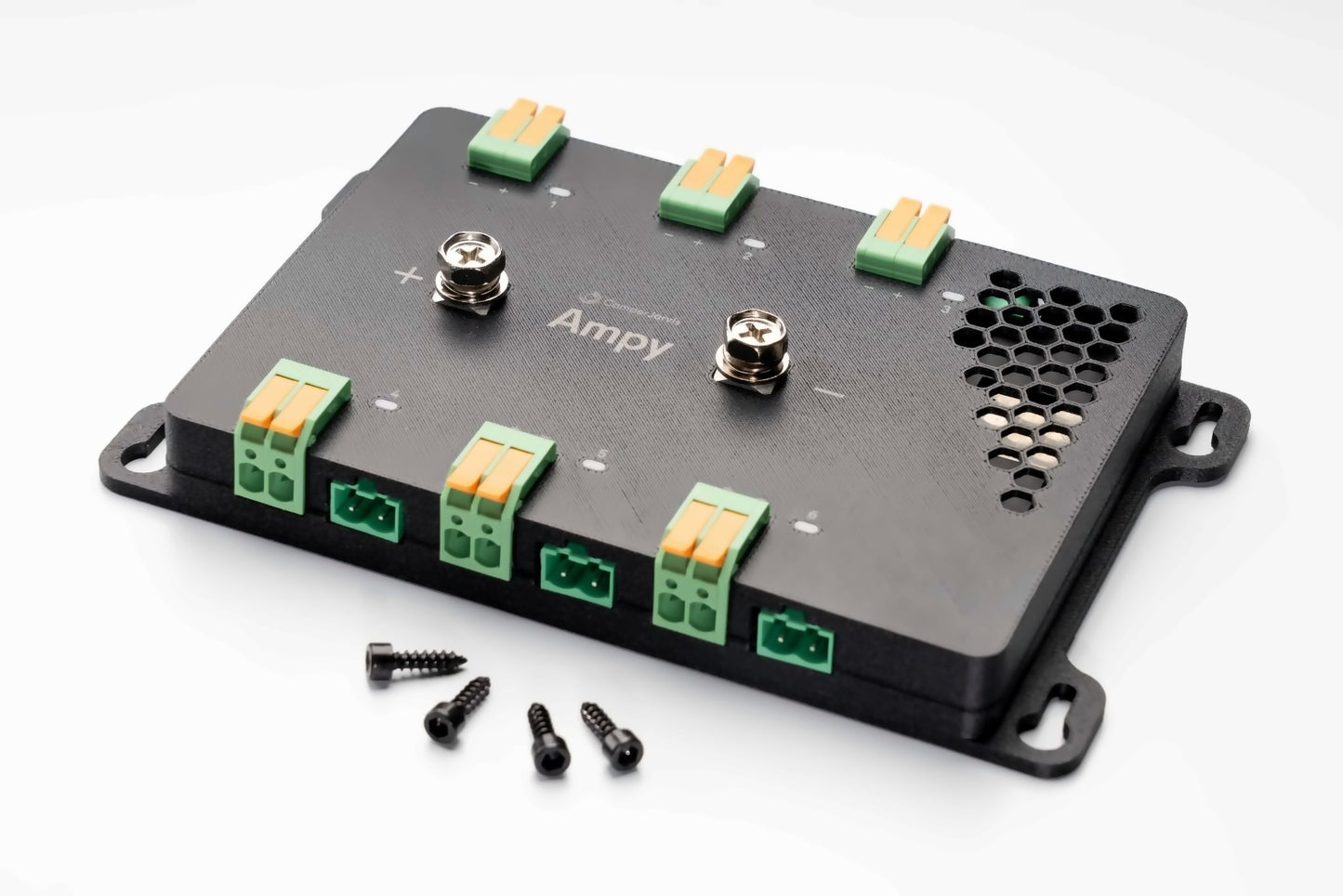
Ampy at a glance

Fuses you adjust
Six electronic fuses from 0.5A. Tripped? One tap resets it.
Consumption live
Voltage, current and power for every output, measured rather than estimated.
Strong enough for everything
24A continuous per output, 120A in total. For fridge, inverter and heater.
Dimming included
Every output dims up to 5A, without an extra device.
Wall push buttons built in
Every output takes a push button or switch. It switches directly, while fuses and voltage protection work inside the device.
Safety like in a car
Developed to ISO 26262 up to ASIL B, with an independent second watchdog.
From real builds

Really cool, works right away, water pump switched with a matching Berker switch at the sink, so no wet fingers on the SmartKnob.
StefanSelf-build in a Citroën JumperTranslated from German

Frequently asked questions about Ampy
Does Ampy work on 12V and 24V?
Both. Ampy detects the vehicle's electrical system automatically, so there is nothing to change.
How is Ampy connected?
The supply goes onto two M6 threaded studs, the loads into lever terminals for up to 4mm²: open, insert, close, no tools needed. The push button wires go into removable spring terminals.
How much current can an Ampy output draw?
24A continuously, up to 32A for short periods, and 120A across all six outputs combined. So even a compressor fridge, an inverter and a parking heater fit on a single output.
Do I still need to buy fuses for Ampy?
Not for the loads connected to Ampy. Every output has an electronic fuse that you adjust instead of replacing.
What happens when a fuse on Ampy trips?
The output switches off and you see it in the dashboard, including the reason. Resetting takes a single tap. If the fuse trips several times in a row, Ampy enforces a short pause so that a genuine fault is not simply glossed over.
Fast, normal or slow: which tripping characteristic should I choose?
The characteristic determines how quickly the fuse cuts out when the current is too high. As a rule of thumb: slow for anything that briefly draws more when it switches on, fast for pure electronics, normal for everything in between.
- Choose slow for motors and compressors: water pump, fridge, fan, awning, pop-top roof, inverter. These loads draw several times their continuous current at the moment they switch on, which is completely normal. A fast fuse would trip every time, even though nothing is wrong.
- Choose fast for loads without inrush current, such as LED strips, sensors, control units or charging sockets. Here a sudden rise in current is almost always a fault, and then it should cut out quickly.
- Normal is the safe choice if you are unsure.
A practical tip: if the fuse only trips at switch-on while the continuous current is fine, set it one step slower. Raising the fuse rating instead would be the wrong approach, because the rating still has to match the cable cross-section.
Can I keep my old fuse box alongside Ampy?
Yes. Many people only move the loads they want to switch or measure to Ampy and leave the rest in the old fuse box.
What do undervoltage protection and overvoltage protection mean?
They switch an output off when the system voltage drops below a set limit (undervoltage protection, UVP) or rises above one (overvoltage protection, OVP). You set both limits for each load.
- Undervoltage protection stops the battery from being drained too far (deep discharge) and protects your devices from overheating at too low a voltage. Motors and compressors actually draw more current when the voltage drops.
- Overvoltage protection keeps voltage spikes away from sensitive electronics, for example during an equalisation charge or if the alternator develops a fault.
Because you set the limits per load, you can switch things off in stages: the inverter and outside light go first, the heating and interior lights stay on the longest.
With lithium batteries, set the lower limit so that it kicks in before the battery's own protection electronics (the battery management system, BMS) shut down. Otherwise everything suddenly goes dark.
Can I see what each device connected to Ampy consumes?
Yes. Voltage, current and power are measured and displayed for each output.
Can I dim lights with Ampy?
Yes, any output up to 5A. For coloured ambient lighting with RGBWW, Lighty is the right choice.
Can I connect my electric pop-top roof or awning to Ampy?
Yes. Two outputs form a direction pair, and Ampy makes sure the two directions are never active at the same time. A set run time or limit switches stop the movement automatically.
Can I operate Ampy without a phone?
Yes. A push button or wall switch can be connected to every output, and on the SmartKnob you can do everything without a phone too.
Can the water pump switch off automatically?
Yes. In the dashboard, link the pump to the radar widget under Functions. It then switches on as soon as someone is in the vehicle and off again after you leave, with an adjustable delay.
Can I change Ampy's settings later?
At any time. Fuse rating, tripping behaviour, voltage limits, name, icon and push button mode can all be changed in the interface, without tools.
What happens to Ampy after a power cut?
If only Ampy loses power, it restores the last state of its channels by itself once power is back. Devices that were running before, such as a heater or a fridge, start again. All settings are retained. A heating element controlled by the Boiler widget is restored the same way. Exception: if Ampy had already switched it off and locked it because the SmartKnob stopped responding, it stays off until you deliberately reset the fuse.
What happens to a heating element on Ampy if the SmartKnob fails?
It switches itself off after 10 minutes and stays off until you deliberately reset the fuse in the dashboard. That is because the boiler control, meaning the cut-off temperature and dry-run protection, runs on the SmartKnob. This way your boiler never heats unattended.
All other loads on Ampy carry on running as normal.
More questions? All answers in the knowledge centre or write to us.


